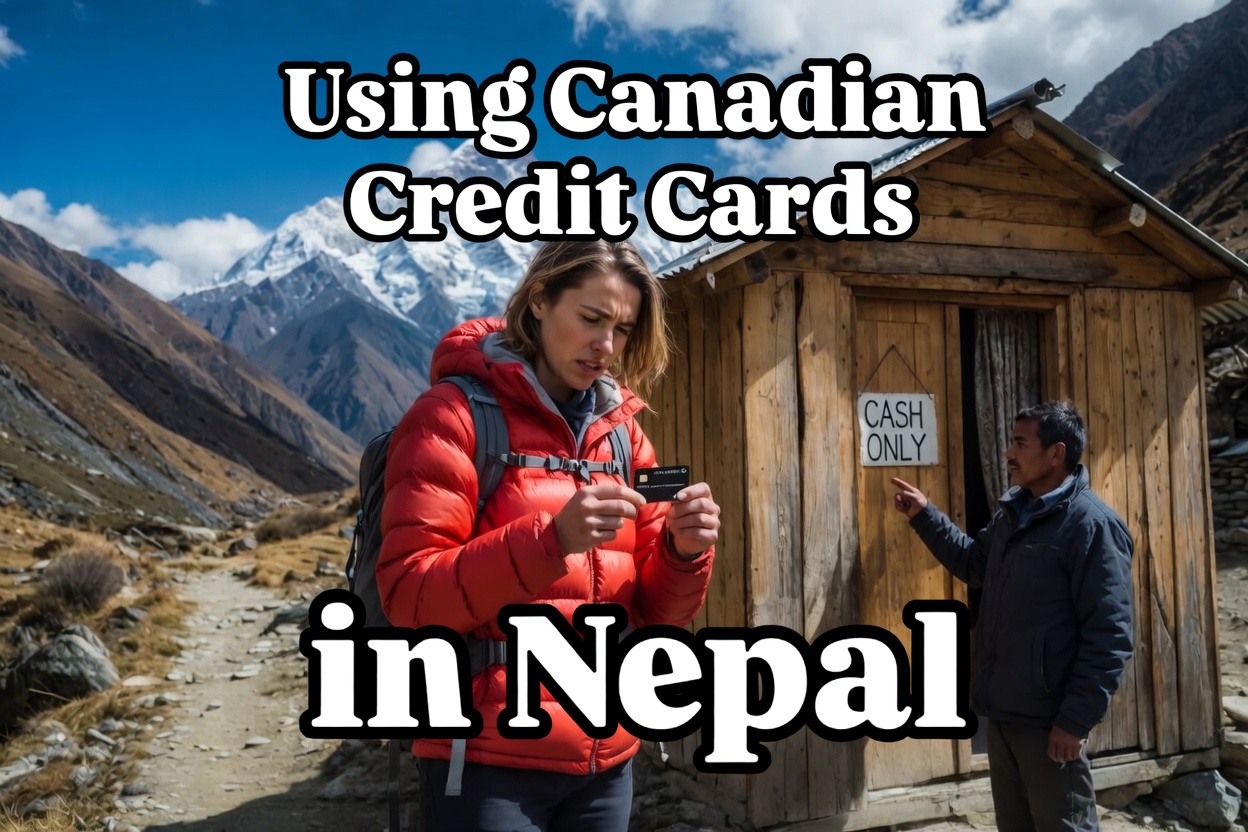
Canadian travelers often assume their credit card will work the same way in Nepal as it does at home. In practice, the experience is very different, especially once you leave Kathmandu.
From our daily operations at RM Treks, the biggest financial issues Canadian trekkers face are not fraud or lost cards. They are far simpler problems: ATMs with limits, card machines that stop working, unexpected fees, and running out of cash halfway up the trail.
This guide explains how Canadian credit and debit cards actually perform in Nepal. This article is based on our real trekking logistics experience in Everest, Annapurna, and Langtang regions.
Where Canadian Credit Cards Work in Nepal
Reliable card acceptance (mostly in cities)
In Kathmandu and Pokhara, credit cards are widely accepted at:
- Mid-range and high-end hotels
- Larger restaurants
- Trekking gear shops
- Travel agencies
- Domestic airlines
Visa and Mastercard are the most commonly accepted networks. American Express is far less reliable outside a few major hotels.
In these environments, Canadian cards usually work without issue, but you will still pay foreign transaction fees unless you have a no-FX card. Most Canadian credit cards charge around 2.5% per foreign transaction, in addition to the network exchange rate.
Limited or unreliable card acceptance on trekking routes
Once you leave the main cities, the situation changes quickly.
On popular trekking routes such as Everest Base Camp trek, Annapurna Base Camp trek, Langtang Valley trek, card payments are:
- Rare in smaller villages
- Dependent on solar power or unstable electricity
- Affected by internet outages
- Often subject to extra “card surcharge” fees
In many lodges, card machines exist but are simply not operational on a given day. From an operational perspective, we always tell our clients that if you rely only on a credit card, you will eventually run into a payment problem on the trail.
Why Credit Cards Fail More Often While Trekking
There are three main reasons.
1) Power and network instability
Card terminals depend on mobile data or satellite internet. Snow, storms, or power outages can stop transactions for hours or days.
2) Small-business economics
Remote tea houses operate on tight margins. Card processing fees of 3–4% can be significant, so many prefer cash.
3) Settlement delays
Some lodges accept cards but only process transactions once they return to a larger town. This can sometimes lead to delayed charges, unexpected exchange differences and duplicate authorization holds
The Real Cost of Using a Canadian Credit Card in Nepal
Many travelers focus only on the “2.5% FX fee,” but the actual cost is made up of several layers.
Typical cost structure for a Canadian credit card abroad
| Cost component | Typical range | Who charges it |
|---|---|---|
| Exchange rate spread | ~1–2% | Visa / Mastercard |
| Foreign transaction fee | ~2.5% | Canadian card issuer |
| Merchant surcharge (common in Nepal) | 3–4% | Local business |
This means a single purchase could cost 5–8% more than the local cash price.
Example: Hotel payment in Kathmandu
| Item | Local price | Card total (typical) |
|---|---|---|
| Hotel room | NPR 10,000 (~CAD 105) | CAD 110–113 |
| FX fee (2.5%) | + CAD 2.60 | |
| Exchange spread (~2%) | + CAD 2.10 | |
| Merchant card fee (3%) | + CAD 3.15 |
Total real cost: about CAD 7–8 extra on a CAD 105 stay.
This is why many hotels offer a lower price for cash.
Why “No-FX” Cards Help, But Don’t Solve Everything
Some Canadian cards remove the 2.5% foreign transaction fee. These are useful, but they do not eliminate all extra costs.
Even with a no-FX card:
- You still pay the network exchange spread.
- Many Nepali businesses add their own card surcharge.
- Card acceptance may still fail due to power or connectivity.
So a no-FX card is a good tool—but not a full solution for trekking.
ATM Access: What You Should Expect
ATMs are the main way foreign trekkers get cash in Nepal.
Current withdrawal limits (2025–2026)
Nepal Rastra Bank regulations currently set:
- NPR 20,000 per transaction
- NPR 50,000 per day
- NPR 300,000 per month
That equals roughly:
- CAD 200 per withdrawal
- CAD 500 per day (approx.)
These limits apply regardless of how high your Canadian card limits are.
Common ATM realities in trekking towns
In places like Namche Bazaar, Lukla, or Manang, ATMs might not be as reliable as in the major cities. You may face issues such as:
- ATMs running out of cash
- Machines may be offline for days
- Only one or two ATMs may exist
- International cards may work intermittently
Operationally, we advise all clients to withdraw their full trekking cash before leaving Kathmandu or Pokhara.
Debit vs Credit Cards for Canadians in Nepal
Quick comparison
| Factor | Credit Card | Debit Card (ATM use) |
|---|---|---|
| Best use | Hotels, flights, big expenses | Withdrawing trekking cash |
| FX fees | Usually 2.5% | Often similar or higher |
| Fraud protection | Stronger | Weaker in some cases |
| Cash access on trail | Rare | Main method via ATMs |
| Interest on cash advance | High and immediate | Not applicable |
Real Trekking Payment Scenarios (From Daily Operations)
Scenario 1: Hotel payment in Thamel
You pay a Kathmandu hotel by credit card. The hotel adds a 3% surcharge, and the Canadian bank adds 2.5% FX. The total bill ends up about CAD 15 higher than the quoted price.
Scenario 2: Withdrawing trekking cash
You withdraw NPR 20,000 four times at different ATMs because of per-transaction limits. Each withdrawal has a local ATM fee plus Canadian bank charges, adding CAD 20–30 total in fees.
Scenario 3: Running out of cash in Namche
You try to use a credit card in a tea house. The card machine cannot connect to the network. You must need to borrow cash from another trekker until reaching the next ATM.
Scenario 4: Card blocked during trek
Your Canadian bank flags a transaction in Nepal as suspicious. The card stops working. You have no backup card and must rely entirely on cash for the rest of the trip.
The Most Practical Card Strategy for Canadians
From our experience supporting Canadian clients every season, the most reliable approach is 1 credit card + 1 debit card + sufficient cash.
Typical breakdown:
| Purpose | Best payment method |
|---|---|
| Hotels in cities | Credit card |
| Trekking expenses | Cash |
| Emergency funds | Backup credit card |
| ATM withdrawals | Debit card |
How Much Cash to Carry on a Trek
This depends on the region and duration, but typical daily trekking costs are:
| Region | Daily cash estimate |
|---|---|
| Everest region | CAD 40–60/day |
| Annapurna region | CAD 30–50/day |
| Langtang region | CAD 25–45/day |
You can see full breakdowns in:
- https://rmtreks.com/everest-base-camp-cost-for-canadians-in-cad/
- https://rmtreks.com/nepal-trekking-from-canada/
Common Myths About Using Canadian Cards in Nepal
“Credit cards work everywhere on popular treks”
They work in some larger lodges, but outages and surcharges are common. Cash is still the primary payment method on most trails.
“A no-FX card means no extra costs”
You still pay the exchange spread and any merchant surcharge.
“I can just use ATMs along the trek”
ATMs are limited, often empty, and subject to daily withdrawal caps.
Trek Planning Resources
For region-specific cost planning:
- https://rmtreks.com/trip/everest-base-camp-trek/
- https://rmtreks.com/nepal-trekking-from-canada/
- https://rmtreks.com/category/travel-guide/canadian-travel-guide/
- https://rmtreks.com/category/travel-guide/
These pages explain where cash is required and typical daily spending.
External References
- Canadian government travel money advice
- Scotiabank foreign currency conversion fee details
- Ratehub explanation of foreign transaction fees
- National Bank Canada FX fee explanation
- Nepal Rastra Bank ATM withdrawal limit update
- ATM limits summary for foreigners in Nepal
FAQs: Using Canadian Credit Cards in Nepal
Yes, Canadian Visa and Mastercard credit cards usually work in major hotels, restaurants, and travel agencies in Kathmandu and Pokhara, but they become unreliable or unusable in smaller towns and on trekking routes where cash is still the main payment method.
Most Canadian credit cards charge about a 2.5% foreign transaction fee on purchases made in Nepali rupees, and this is added on top of the exchange rate used by the card network.
Credit cards are accepted only in a few larger lodges on the Everest trail, and even there transactions often fail due to network or power issues, so trekkers must carry enough cash for daily expenses.
Yes, a debit card is important because it allows you to withdraw cash from ATMs in Kathmandu and Pokhara, which is the main way to obtain trekking money.
Most ATMs in Nepal allow withdrawals of about NPR 50,000 per day, with a limit of around NPR 20,000 per transaction, regardless of your Canadian bank’s higher limits.
Many hotels add a 3–4% surcharge when you pay by credit card, which is separate from the foreign transaction fee charged by your Canadian bank.
Paying cash is usually cheaper because credit card payments often include merchant surcharges, exchange rate spreads, and foreign transaction fees.
You should not rely on ATMs during a trek because machines in mountain towns frequently run out of cash or stop working due to power or network problems.
If your card stops working, you may not be able to access funds until you reach a major city, which is why it is important to carry enough cash and a backup card.
Yes, it is generally safe to use credit cards in reputable hotels, airlines, and agencies, and credit cards usually offer better fraud protection than debit cards.
Most Canadian banks charge foreign ATM withdrawal fees and currency conversion fees, and the local ATM in Nepal will also charge a separate machine fee.
American Express is accepted only at a few large hotels and businesses in major cities, so it should never be your only card in Nepal.
Most trekkers should carry enough cash to cover their full trek plus a small buffer, usually between CAD 400 and CAD 900 depending on the region and duration.