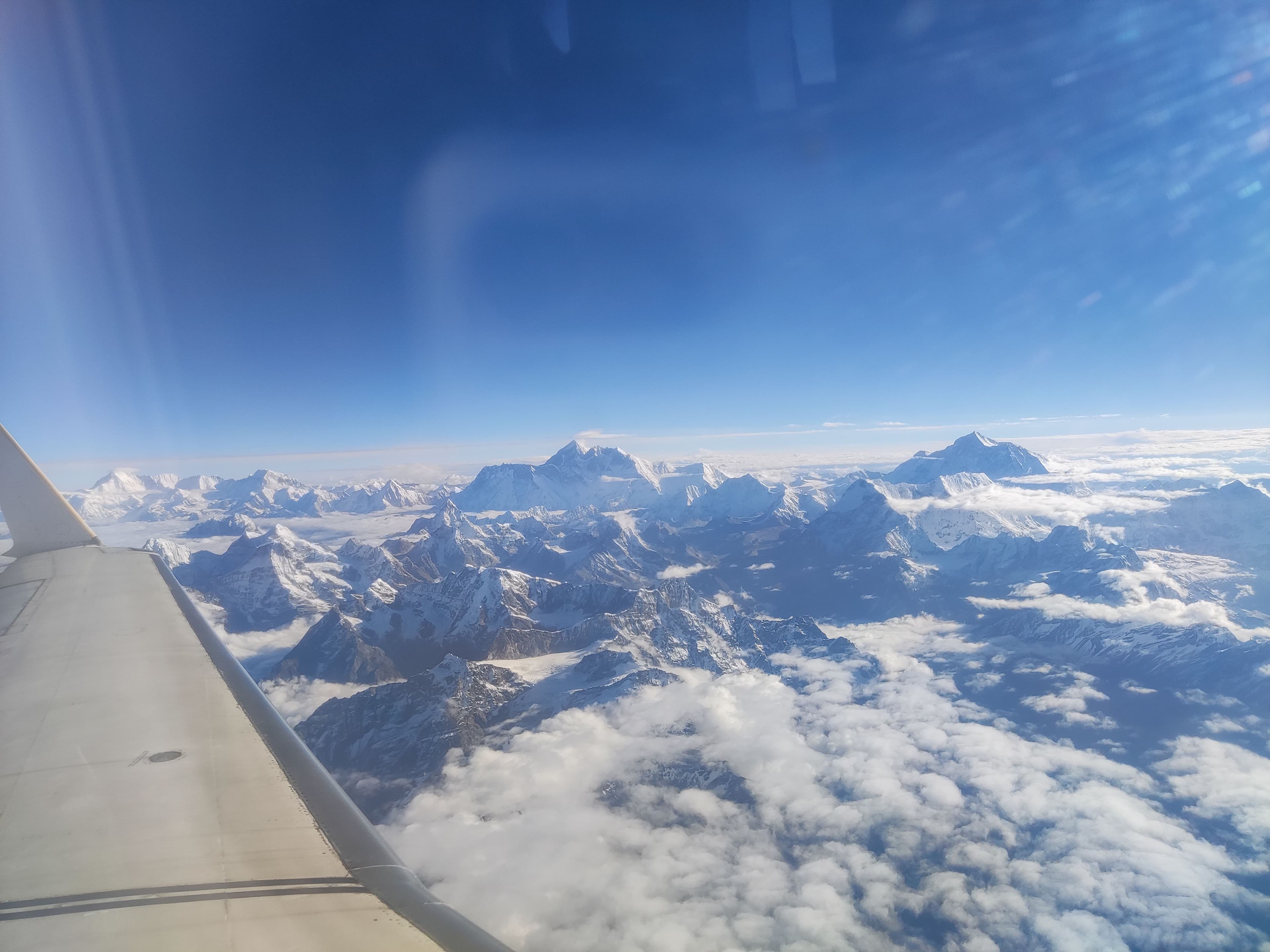
The mountain flight follows the Himalayan range from west to east before returning to Kathmandu.
1. Ganesh Himal and Langtang
The first major Himalayan landscapes appear north of Kathmandu. The Ganesh Himal range and the peaks around Langtang form the beginning of the high-mountain panorama. Langtang Lirung, at 7,234 metres, is one of the most prominent peaks in this section.
You can also see the surrounding ridges and peaks of the central Himalayas as the aircraft continues east.
A Little Fact:
The Langtang Lirung you see from the flight is part of a landscape shaped by glaciers, steep valleys and powerful geological forces. In August 2026, a major glacier-and-rock collapse in the Langtang region triggered a destructive flood and debris surge downstream, damaging homes, farmland, roads, bridges and other infrastructure.
The event affected thousands of households and damaged more than 50 km of roads, dozens of bridges and over 1,800 hectares of agricultural land. What looks like a quiet, snow-covered mountain from the aircraft is therefore also part of a rapidly changing Himalayan environment.
2. Everest and the Khumbu Himalaya
Further along the route, the mountains become increasingly imposing.
This is where Mount Everest appears, surrounded by some of the best-known peaks in the Khumbu. Lhotse, the world's fourth-highest mountain, rises immediately beside Everest.
Nuptse forms another major part of the Everest skyline, while the distinctive pyramid of Ama Dablam stands farther south.
Other prominent mountains in this section include Pumori, Thamserku, Kangtega, Taboche and Lobuche, along with many surrounding peaks and ridges.
From the air, you can see how these mountains fit together as one enormous landscape rather than as separate names on a map.
3. Makalu
Continuing east brings the airplane towards Mount Makalu, the world's fifth-highest mountain at 8,485 metres. The landscape here is increasingly remote and mountainous, with enormous ridges and snow-covered peaks stretching toward the eastern Himalayas.
4. Kanchenjunga
The eastern end of the mountain panorama reaches toward Kanchenjunga, the world's third-highest mountain at 8,586 metres.
Seeing Kanchenjunga in the same flight as Everest gives you a sense of the extraordinary scale of Nepal's Himalayan range. These are not isolated mountains. They are part of one enormous mountain system extending across the northern edge of the country.
After reaching the eastern Himalayan section, the aircraft turns back toward Kathmandu.